
Table of Contents
Most parents searching for a bracelet kit are not asking, “Which one is best?” They’re asking two quieter questions: Is this safe for my child? And will my child actually use it, or will it end up in a drawer after twenty minutes?
This guide answers both. We cover what safety certifications mean in plain language, how to match a kit to your child’s specific age and attention span, and the red flags that most product listings are careful not to mention.
What parents are actually trying to figure out
The bracelet kit market is full of products that look similar in photos. A box of colorful beads, a spool of cord, maybe some tools—from a thumbnail image, it’s hard to tell what you’re actually getting.
What you’re actually trying to figure out, before you buy, is the following:
Whether the materials are safe for a child to handle and wear against skin. Whether the kit is designed for the age of your specific child — not just “ages 6+” in small print. Whether everything needed to finish a bracelet is actually in the box. And whether the experience of opening this kit will hold your child’s attention long enough to produce something they’re proud of.
Those are different questions from “which has the best reviews,” and they require different information to answer.
Safety first: what ASTM F963 means and why it matters
ASTM F963 is the US toy safety standard administered by the American Society for Testing and Materials. For a bracelet kit, it means the materials have been tested by an accredited third-party laboratory for:
- Chemical safety — heavy metal content including lead and cadmium, which can be present in dye pigments and surface coatings on cheaper beads. The standard sets specific limits for both.
- Mechanical safety—bead size relative to choking hazard guidelines and cord strength under expected use conditions.
- Flammability — materials meet minimum standards for flame resistance.
We went through this process ourselves. During our first round of testing, one batch of beads was flagged for slightly elevated chromium levels. We chose to redo the entire production run and went through three rounds of laboratory documentation to ensure every single bead met the ASTM F963 safety threshold.
For a kit that will be handled by a child—beads touching hands, cord going near mouths during threading—ASTM F963 certification is the minimum standard worth looking for. EN71, the European equivalent, covers similar ground and is equally valid.
Age suitability: matching the kit to the child
“Ages 6 and up” covers a wide range. A six-year-old and a twelve-year-old need fundamentally different things from a bracelet kit. Here’s how to think about it by age band:
Ages 5–6: Supervised introduction
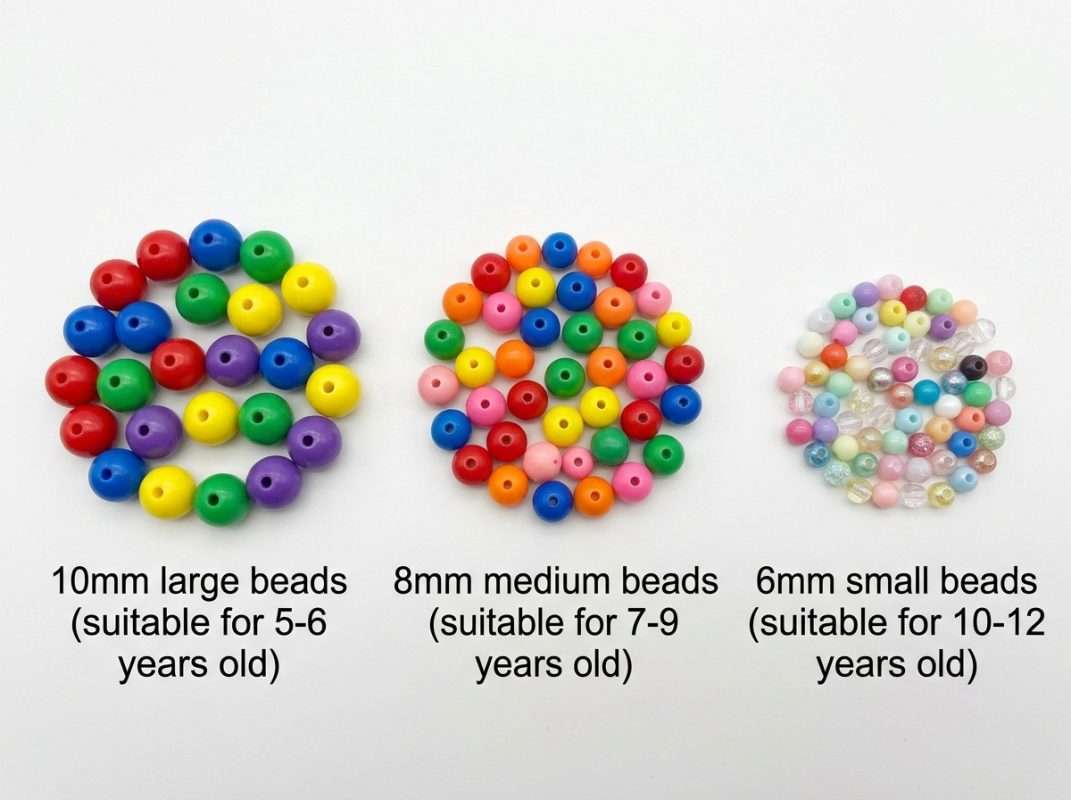
At this age, fine motor skills are still developing. The priority is large beads with wide holes — 10mm or larger — that a small hand can grip and thread without frustration. Elastic cord should be pre-cut by an adult. The goal is one completed bracelet with help. Standard 6mm beads are often too small for this age group to thread independently.
Ages 7–9: Growing independence
This is the core age range for most bracelet kits. Children at this age can manage 6mm–8mm beads independently and follow a simple instruction card.
When we first tested our prototypes with a colleague’s 6 and 8-year-old daughters, we noticed they could thread beads easily but struggled to pull the final knot tight enough. This observation led us to design a dedicated card with a three-step visual guide for the Surgeon’s Knot, which we now include in every kit. A physical printed guide they can refer to while their hands are occupied is far more effective than a QR code to a video.
Ages 10–12: Ready for complexity
At this age, children can manage letter beads and independent design planning. They’re also the group most likely to want to make something specific — a bracelet with their name or a matching set for a friend. This group is most likely to be frustrated by a kit that runs out of material too quickly. Look for kits with at least 3,000–5,000 beads to allow for meaningful experimentation.
| Age | Bead size | Independence level | Key requirement |
| 5–6 | 10mm+ | Supervised | Oversized beads, adult-cut cord |
| 7–9 | 6mm–8mm | Light guidance | Printed instruction card, 0.8mm cord |
| 10–12 | 6mm–7mm | Independent | Letter beads with vowels, 3,000+ beads |
What should actually be in a kids’ bracelet kit
A complete kit for a child needs to include everything from the first bead to the finished bracelet. Here’s what that actually means:
- Elastic cord at 0.8mm or above. The most common failure point in budget kits. Our 0.8mm TPU cord is tested to withstand 5,000+ stretch cycles. Thin 0.5mm cord breaks under normal use, which for a child means a broken bracelet and a safety issue with scattered beads.
- Enough beads to make more than one bracelet. A kit with only enough material for one or two bracelets ends the activity too quickly. A standard Beadlo kit includes 5,000 beads in 48 colors, which is enough to make 50+ adult bracelets (and significantly more at child wrist sizes).
- A physical instruction card. A card they can put on the table next to their beads. Our design features large-font illustrations that allow a child aged 7 and up to follow the process independently.
- Scissors appropriate for a child’s hands. We include rounded-tip scissors with a smaller grip, ensuring the tool is safe and manageable for smaller hands.
- A storage solution. A 48-compartment storage box, with one color per compartment, means the activity can be put away and picked up again without a 20-minute sorting session.
Red flags: what to avoid when buying
- No certification listed. A listing that says “safe for kids” without referencing a specific standard (ASTM F963 or EN71) has made a claim, not a commitment.
- Cord thickness not mentioned. If the listing doesn’t specify thickness, assume it is the 0.5mm standard that is prone to snapping.
- “Complete kit” with no tool list. Look for listings that specifically state if scissors and instruction cards are included.
- No return or replacement policy. A brand that doesn’t offer a straightforward replacement path for manufacturing issues often has inconsistent quality control.
Why we built Beadlo with kids in mind
We designed Beadlo specifically around the ways kids’ craft kits fail—cord that breaks, kits that run out too fast, and letter bead packs that don’t have enough vowels.
- Safety: All Beadlo materials meet ASTM F963 standards. Certification documents are available on request for schools and activity programs.
- Cord: We use 0.8mm elastic cord. It survives the repeated stretching of a child putting a bracelet on and taking it off.
- Bead quantity: With 5,000 beads in 48 colors, the activity has room to develop into a genuine hobby.
- Letter beads: Vowels — A, E, I, O, U — are included at double the quantity of consonants. This ensures a child can actually spell their name and their best friend’s name.
- Instructions: Our printed instruction card was born from a real classroom need. When a school inquired about a bulk order, I created a large-font knotting guide specifically for younger students, and it worked so well it became a permanent part of our kit.
If you’re buying for a child aged 7–12, our kids’ bracelet making kit has the full contents list and age guidance. For a broader overview, our beginner’s guide to bracelet making covers the first session from start to finish.
Questions parents ask before buying
At what age can a child use a bracelet making kit independently?
Most children can thread 6mm–8mm beads and tie a simple knot independently from around age 7–8. Ages 5–6 benefit from adult help throughout. Ages 10 and up can typically manage the full process without assistance.
Are the beads a choking hazard?
Standard 6 mm–8 mm beads are above the choking hazard threshold for children under 3 but should be treated with care around younger siblings. Always supervise children under 6 and ensure beads are stored in a closed container.
How long does a bracelet making session typically last?
For ages 7–9, one bracelet takes 15–20 minutes. A full session usually runs 45–60 minutes. For ages 10–12, sessions often run longer due to more elaborate design planning.
Can the kit be used as a party activity?
Yes. Pre-cut cord lengths, set out pre-sorted bead selections, and have the instruction card visible. For groups of 8–10 children, one standard kit provides enough material for a 30–40 minute activity.
What happens if pieces are missing or the cord breaks?
Contact us directly. We will replace missing components or defective cables without requiring the return of the entire kit. We also include a spare length of cord in each kit specifically for this reason.
About this article
Written by Maya Dillon, Founder at Beadlo.
Content is based on hands-on kit testing, direct supplier evaluation, and questions collected from our customers.
Where conclusions are based on our own observation rather than third-party testing, this is noted in the text.
Last reviewed: April 2026
