
Table of Contents
After testing these projects across different skill levels and materials, one thing is clear: the gap between “I want to try this” and “I actually finished something” is almost always a materials problem, not a skill problem. The right beads, the correct cord thickness, and a project matched to your current patience level — those three things determine whether you finish a bracelet today or give up halfway through.
The 10 projects below are organized by complexity. Each one includes a difficulty rating, a realistic time estimate, and a specific materials list based on our real-world kit testing. Start at the level that matches where you are right now.
Before you pick a project
Every project in this guide uses the beaded elastic bracelet format—beads threaded onto elastic cord, finished with a surgeon’s knot. If you’ve never made a bracelet before, read our step-by-step beginner guide first—it covers the one knot you need to know and takes 10 minutes.
For all projects: use 0.8mm elastic cord minimum. Based on our stress tests, standard 0.5mm cord snaps under normal wear, while our 0.8mm TPU cord is rated for 5,000+ stretch cycles. For letter bead projects specifically, 1mm cord is better to prevent bead rotation.
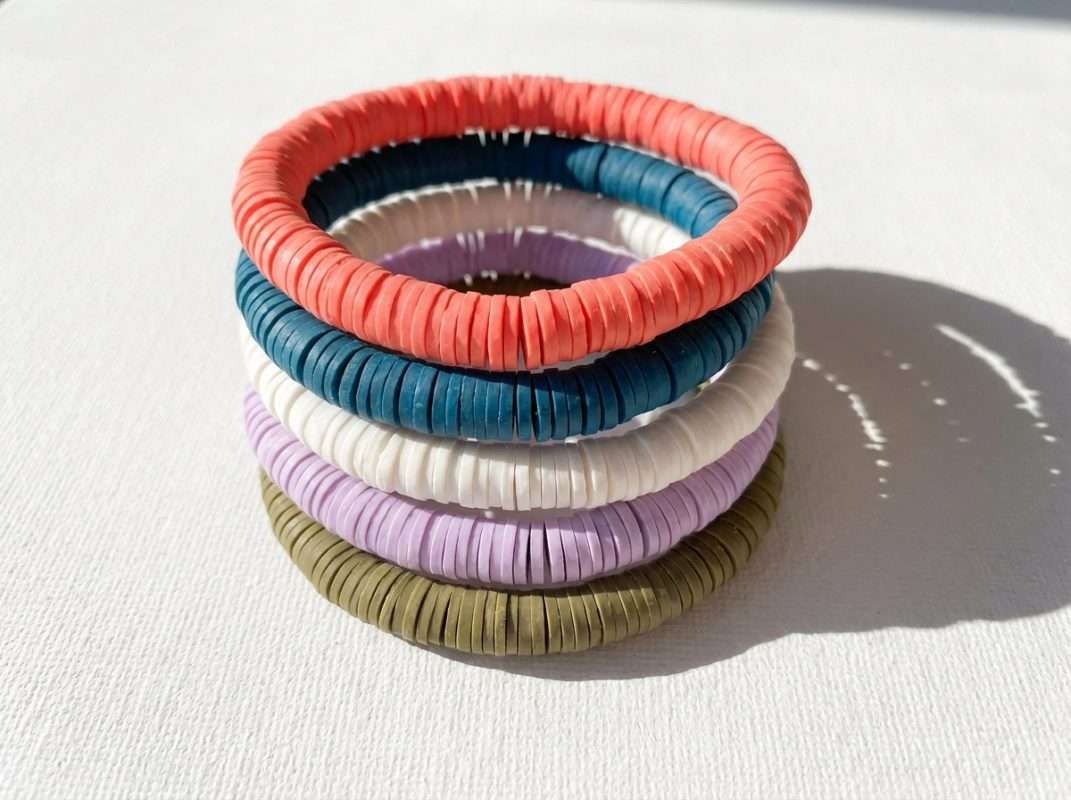
Project 1: The Classic Clay Stack
- Difficulty: ⭐ Beginner — no decisions required
- Time: 10–15 minutes per bracelet
- Best for: First-time makers, ages 6 and up
The simplest possible beaded bracelet: one color of clay heishi beads, threaded in order, tied off. The “stack” part means making three to five in different colors and wearing them together.
Materials:
- Clay heishi beads in 3–5 colors (roughly 45–50 beads per bracelet at 6mm)
- 0.8mm elastic cord
- Scissors + binder clip
How to make it: From what we’ve found when testing color combinations, high contrast makes a stack look intentional. I remember a rainy Tuesday afternoon when I sorted our 48 colors by color temperature, creating 6 distinct palette cards. If you’re unsure, try mixing a warm terracotta with a cool sage—it creates a sophisticated look without any complex pattern-making.
Project 2: Single-Name Letter Bracelet
- Difficulty: ⭐⭐ Easy—some planning required
- Time: 20–30 minutes
- Best for: Anyone spelling a name of 4–6 letters
Materials:
- Letter beads (7mm cube acrylic) — our kits feature vowel-weighted packs to ensure you have enough A’s and E’s.
- Clay heishi accent beads in a contrasting color
- 1mm elastic cord (preferred) or 0.8mm
For more spacing tips and a list of which names work well, see our guide on how to make words on friendship bracelets.
Project 3: Color-Block Two-Tone Bracelet
- Difficulty: ⭐ Beginner
- Time: 15 minutes
- Best for: A deliberate, graphic design
Materials:
- Clay heishi or acrylic round beads in 2 colors
- 0.8mm elastic cord
Divide your total bead count by two. Thread Color A, then Color B. High contrast (like navy and cream) makes the block effect read clearly, while low contrast can look accidental.
Project 4: Friendship Set — Matching Pair
- Difficulty: ⭐⭐ Easy
- Time: 30–40 minutes (for both)
- Best for: Making two bracelets to give one away
Make two identical sequences. A pro tip: swap the proportions. If Bracelet A is 80% coral and 20% sage, make Bracelet B 80% sage and 20% coral. They’ll read as a set without being carbon copies.
Project 5: Evil Eye Bead Bracelet
- Difficulty: ⭐⭐ Easy
- Time: 15–20 minutes
- Best for: A focal centerpiece
Use one 12mm evil eye bead as your center. Frame it with our ASTM F963-certified 6mm clay beads. The contrast in size (12mm vs 6mm) is what makes the center bead look like a boutique find rather than a random addition.
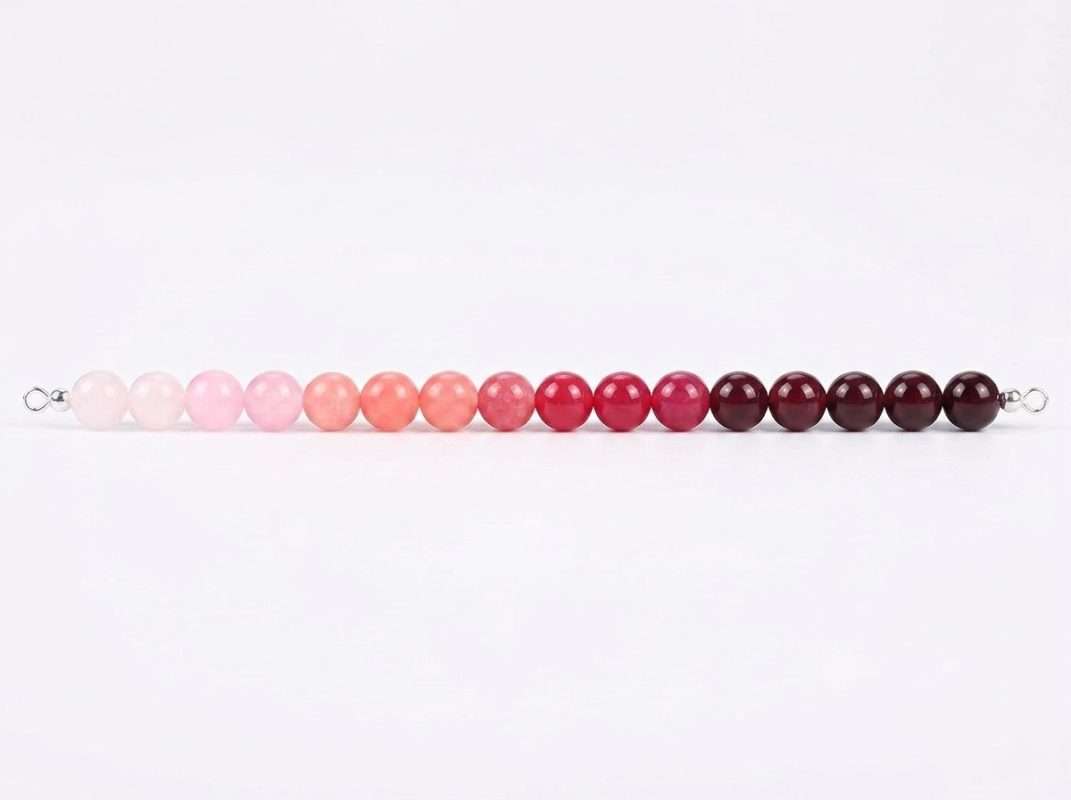
Project 6: Gradient / Ombre Bead Bracelet
- Difficulty: ⭐⭐ ⭐ Intermediate
- Time: 20–30 minutes
- Best for: Exploring a full range of colors
This is my favorite way to teach color theory. When I talk to kids about picking colors for a gradient, I ask them, “If this color were a sound, would it be a loud shout or a quiet whisper?” For a smooth ombre, you want your “sounds” to transition slowly from quiet (pastels) to loud (saturated tones). Our 48-color palette was designed specifically to allow for these 5-to-7-stage transitions within the same color family.
Project 7: Word Bracelet — Short Phrase
- Difficulty: ⭐⭐ ⭐ Intermediate
- Time: 30–45 minutes
- Best for: Phrases like “BE KIND” or “STAY GOLD”
At 7mm per letter bead, a phrase like “LOVE YOU” takes up about 5.6cm. On a standard adult wrist (17 cm), this leaves plenty of room for accent beads. If your phrase exceeds 10 letters, it may wrap too far around the wrist to be readable.
Project 8: Mixed Bead Texture Bracelet
- Difficulty: ⭐⭐ Easy
- Time: 15–20 minutes
- Best for: Visual interest without color complexity
Mix 6mm clay heishi with 6mm acrylic rounds. Keeping the diameter identical ensures the bracelet sits flat on the wrist. All our acrylic beads meet the same lead-free and cadmium-free safety standards as our clay collection.
Project 9: Kids’ First Bracelet — 5 Beads Only
- Difficulty: ⭐ Beginner (Ages 6–8)
- Time: 5–10 minutes
- Best for: Building confidence in young makers
Use 5 large 10mm beads with wide holes. Success is the goal here. By limiting the project to 5 beads, a child with a typical 7-minute attention span can finish their work and wear it proudly before losing focus.
Project 10: Stacking Set — 5 Bracelets in One Sitting
- Difficulty: ⭐ ⭐ Easy (Repetitive)
- Time: 60–90 minutes
- Best for: A full arm stack or birthday gifts
When making multiple bracelets in one session, your workspace matters. During the afternoon I assembled 60 sample sets. I realized that beads will inevitably roll if your surface isn’t perfectly flat. Use a bead mat or even a piece of felt to keep your 5,000-bead inventory from ending up on the floor.
What to do after your first project
The first bracelet takes 20 minutes; the fifth takes 10. Once the surgeon’s knot becomes automatic, you can start focusing on complex patterns.
If you want to go deeper on technique, our complete bracelet making guide covers advanced cord and bead variations. If you’re ready to stock up, our clay bead bracelet kit includes everything you need for all 10 projects above—and enough left over for 40 more.
Pick your favorite project and start with the first bead.
Can I wear these bracelets in the shower?
Yes. Our polymer clay beads are water-resistant and won’t fade or lose their texture when wet. The 0.8mm TPU cord also maintains its elasticity in water.
How do I know which bead size to use for these projects?
Most of these projects are optimized for 6mm clay heishi beads and 7mm letter beads. This consistency ensures that all projects in your stack have a uniform, professional look.
What is the best way to store leftovers from multiple projects?
To keep your workspace organized, we recommend a 48-compartment storage box. This allows you to keep your 48 distinct colors separated, preventing the “muddled mix” that makes future design decisions difficult.
About this article: Written by Maya Dillon, Founder at Beadlo. Content is based on hands-on kit testing, direct supplier evaluation, and questions collected from our customers. Last reviewed: April 2026
