
Table of Contents
If you’ve seen a bracelet with someone’s name on it and thought “I want to make one of those” — this is the guide. Spelling words on a bracelet with letter beads is one of the most satisfying things you can do with a simple kit. It’s also where most kits quietly fail you, usually before you open the bag of letters.
Here’s how to do it right.
Before you start: the vowel problem nobody warns you about
Every letter bead kit contains A through Z. What most of them don’t tell you is how many of each letter is included — and that number matters more than almost anything else.
Standard letter bead packs give you equal quantities of every letter. That seems fair until you try to spell EMMA and find only one E in the bag. I remember spending an entire rainy afternoon with Derek, cross-referencing the 2023 list of most popular girls’ names to calculate exactly how many E’s and A’s a standard kit needs. “Are you really counting every single E?” he asked, but I knew that even one missing letter could ruin a child’s creative momentum.
The letters that run out first, in order, are E, A, I, O, and U — the vowels. English words use vowels heavily, names even more so. When you’re evaluating any kit, the first thing to check is whether the vowels are weighted. If not, you’ll likely run out of letters before you’ve made your fifth bracelet.
What you need for a letter bead bracelet
The materials list is short, but the specifications matter for a professional-looking result:
- Letter beads. Our standard size is 7mm cube-shaped acrylic. The flat faces make letters readable, and the cube shape ensures they sit neatly side-by-side on the wrist without rotating.
- Elastic cord. While our standard 0.8mm cord (rated for 5,000+ stretch cycles) works for most projects, letter beads often have slightly larger holes. Using a 1mm cord can fill the hole better, reducing rotation.
- Accent beads. To make the word pop, you need a frame. We recommend 6mm clay heishi beads. Our kit includes 48 designer-curated colors, allowing you to create a high-contrast background that makes white letter beads stand out.
- Safety Essentials. Ensure all beads are ASTM F963 and EN71 certified. This means they are lead-free, cadmium-free, and non-toxic — essential when making jewelry that sits against the skin all day.
How to plan your word or name before you thread
This step is where most people skip ahead and regret it. Do it before you touch the cord.
- Lay your letters out on the table in order. Spell the word on a flat surface first. This lets you check your E and A supply before you’re halfway through threading.
- Count the total beads. A standard adult wrist is 16–17cm, while a child’s wrist is typically 13–15cm. At 7mm per letter bead, you can calculate exactly how many accent beads you need to reach the full length.
- Center your word. To keep the word on top of the wrist, count your accent beads and split them evenly — half before the word, half after.

Step-by-step: how to put letters on a bracelet
- Cut your cord: Cut a piece equal to your wrist measurement plus 5 inches (12cm) to allow for the knot.
- Clip one end: Attach a binder clip 2–3 inches from one end as a stopper.
- Thread accent beads: Start with the first half of your frame.
- Thread your letters: Pick up each bead and check the orientation. A reversed letter means restarting the whole sequence.
- Add a spacer (Optional): Placing a single small bead between letters makes the word more readable and prevents the flat faces from rubbing.
- Tie the Surgeon’s Knot: This is the only knot we recommend for 0.8mm or 1mm elastic. Cross right over left, tuck under once, then cross again and tuck under twice before pulling firm.
Words and names that work well — and a few that don’t
Some words are “safer” to plan for than others based on typical letter distributions:
- LOVE — 1 of each letter, low vowel pressure.
- BFF — 3 consonants, no vowels needed.
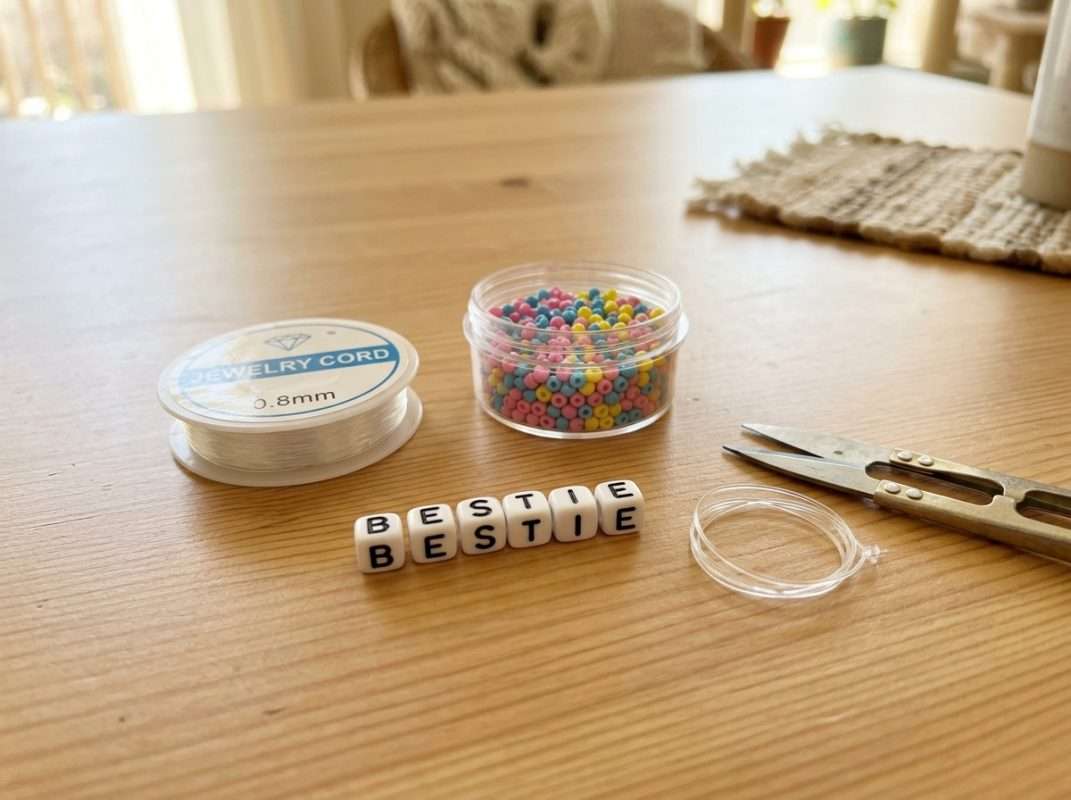
- BESTIE — 2 E’s, 1 I. This is a vowel-heavy word that tests your kit’s depth.
Names that require planning: Names like ELEANOR (4 vowels) or ISABELLA (3 A’s) are the reason we weighted our vowel mix. I’ve seen projects come to a standstill simply because a kit didn’t have enough vowels; I’ll never forget a student named Emma who almost burst into tears when she realized her third ‘E’ was missing from a cheap bulk pack.
Because we know these names are among the most common for girls aged 6–14, we designed our kits to ensure you don’t run out of the letters that matter most.
The Beadlo letter bead advantage
We built our letter bead mix around the observation that names aren’t distributed equally. Our kits include A, E, I, O, and U at roughly double the quantity of consonants.
Every Beadlo kit provides:
- 5,000 beads in 48 colors — enough to make 50+ adult bracelets.
- 7mm cube letter beads for maximum readability.
- ASTM F963-certified materials that are non-toxic and skin-safe.
- 0.8mm TPU elastic cord tested to withstand the daily wear and tear of a busy life.
If you’re ready to start spelling, our letter beads and friendship bracelet kits are organized and ready to go. Pick your word, lay out your letters, and create something that lasts.
Why do my letter beads keep rotating on the wrist?
This usually happens if the cord is too thin for the bead’s hole. While our 0.8mm cord works well, using a 1mm cord with 7mm cube letter beads provides a snugger fit that keeps the letters facing forward.
How do I hide the knot in a letter bead bracelet?
The best way is to slide the knot into the hole of the nearest letter bead or a larger accent bead. Because our letter beads have a 7mm diameter, the holes are large enough to easily conceal a surgeon’s knot.
What if my kit doesn’t have enough E’s for a specific name?
This is the “vowel gap” most kits ignore. Beadlo kits use a vowel-weighted mix, providing roughly double the quantity of A, E, I, O, and U to ensure you can spell common names like EMMA or OLIVIA without running out.
About this article: Written by Maya Dillon, Founder at Beadlo. Content is based on hands-on kit testing, direct supplier evaluation, and questions collected from our customers. Where conclusions are based on our own observation rather than third-party testing, this is noted in the text. Last reviewed: April 2026
