
Table of Contents
Most people searching for a beginner bracelet kit are asking the wrong question. “Which kit is best?” is not as useful as “Which kit won’t frustrate me in the first ten minutes?” Those two questions have different answers — and most buying guides only address the first one.
This guide addresses the second. We’ll tell you what separates a kit that works from a kit that looks good in the product photo, what type of kit makes the most sense for your situation, and why we built Beadlo the way we did.
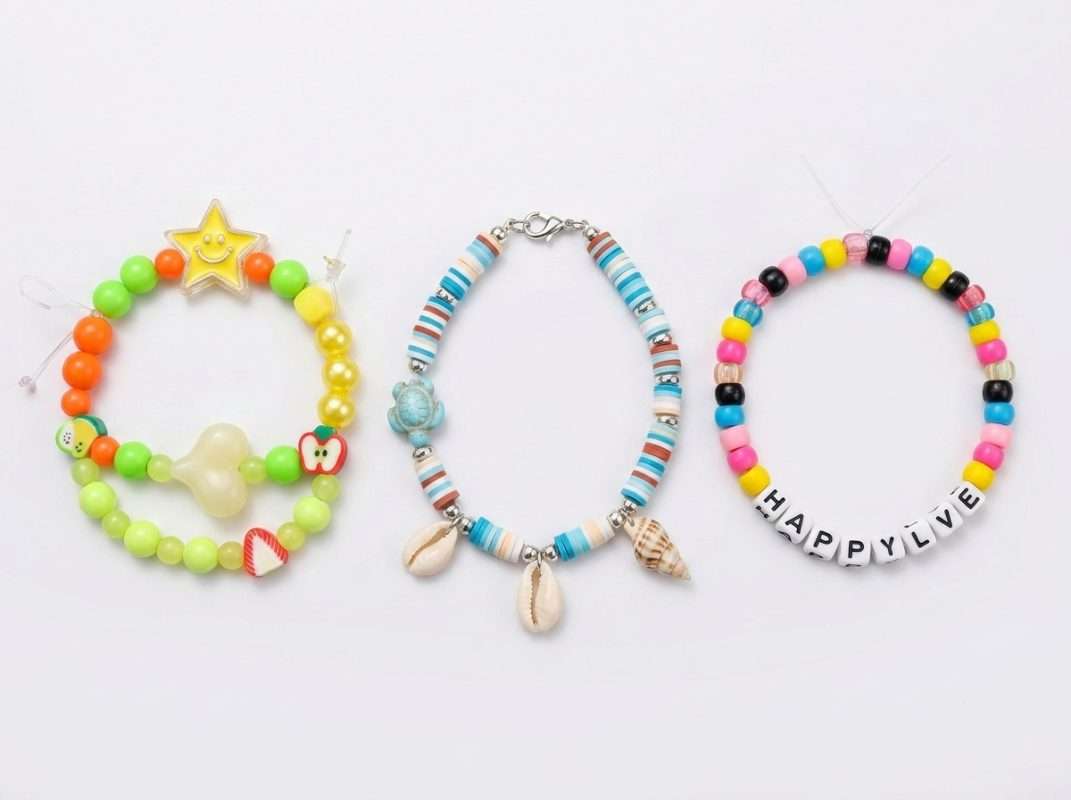
What kind of kit are you actually looking for?
Before comparing options, it helps to be specific about what you want to make. “Bracelet making kit” covers a wide range of products — and a kit built for one style of bracelet will frustrate you if you’re trying to make another.
The three main types a beginner will encounter:
- Clay bead kits — You thread pre-made polymer clay (heishi) beads onto elastic cord. No weaving, no tools beyond scissors. The finished bracelet looks polished and the process is genuinely beginner-friendly. This is where most people should start.
- Friendship bracelet kits — You knot embroidery thread in repeating patterns. Slower to learn, requires following a chart. Beautiful results, but the learning curve is steeper than most beginners expect.
- Charm bracelet kits — You attach charms to a chain using jump rings and pliers. Requires more tools and more precise hand control.
If you’re buying for a child aged 6–12, or if you’ve never made a bracelet before, a clay bead kit is almost always the choice that leads to a finished piece in the first sitting. The rest of this guide focuses on that category.
The one thing most beginner kits get wrong
It’s the elastic cord.
Most kits — including many with thousands of positive reviews — include 0.5mm elastic cord. That thickness is insufficient for a bracelet that will hold up under normal use. Buyers frequently ask us whether their creations will last; the truth is that at 0.5mm, the cord often snaps within weeks of regular wear.
Based on the kits we’ve reviewed, this materials problem is the headliner of bad experiences. We decided to solve this by using 0.8mm TPU elastic cord, which is rated for 5,000+ stretch cycles at standard wrist tension. At this diameter, the cord holds a surgeon’s knot reliably and withstands the daily stretching of putting a bracelet on and taking it off. When evaluating any beginner kit, check the cord thickness first. If it’s not listed, assume it’s the thinner variety.
What a good beginner kit actually includes
A kit built for beginners needs to solve the setup problem — the moment between opening the box and making the first bracelet.
Must-have:
- Elastic cord at 0.8mm or above. Non-negotiable for durability.
- Beads in adequate quantity. A starter kit should provide enough material to make at least 50+ adult-sized bracelets. Having 5,000 beads in 48 distinct colors gives you enough range to start making real design decisions rather than just using whatever is left in the tray.
- Letter beads with weighted vowels. Most standard packs include equal numbers of every letter. A well-designed kit accounts for the fact that you will use far more E’s and A’s than Q’s or Z’s.
- Scissors and Tools. Many “complete” kits leave you hunting for your own scissors. A truly all-in-one set includes scissors, a threading needle, and even a measuring tape to remove the guesswork.
- Safety Certifications. Especially for children’s gifts, ensure materials meet ASTM F963 and EN71 standards. This confirms the beads are lead-free, cadmium-free, and non-toxic.
Useful but not essential: A storage box with individual compartments is essential to keep those 48 colors from mixing. Our kit uses a 48-compartment storage box where every color has its own home before it even ships to you.
Kit types compared: which one is right for you?
| Feature | Clay Bead Kit | Friendship Bracelet Kit | Charm Kit |
| Skill needed | None | Some | Some |
| Time to first bracelet | 10–15 min | 45 min+ | 20–30 min |
| Tools required | Scissors only | Scissors + clipboard | Pliers + scissors |
| Best for ages | 6 and up | 10 and up | 12 and up |
| Gift-friendly | Yes | Yes | Less so |
| Result looks like | Polished beaded bracelet | Woven pattern bracelet | Chain with charms |
What we built Beadlo to fix
We designed Beadlo specifically around the failure points we kept seeing in the market. As a former art teacher, I’ve seen the disappointment on a child’s face when a project falls apart because of poor materials.
Here is how we addressed those gaps:
- On the cord: We use 0.8mm elastic cord. Our testing showed it survives 5,000+ stretches, far exceeding the 0.5mm industry standard that leads to so many “my bracelet broke” complaints.
- On letter beads: I remember the afternoon Derek and I spent calculating vowel frequencies in common names. We realized that to spell “ADRIANA” or “BEATRICE,” you need way more A’s and E’s. That’s why we weighted our vowel mix, including roughly double the quantity of A, E, I, O, and U compared to consonants.
- On quality control: My sensitivity to smells is a bit of a curse, but it helps here. I personally smell-test our bead batches to ensure there is no sharp chemical odor, ensuring the ASTM F963-certified materials are as clean as they are safe.
- On completeness: Our kit is a true all-in-one solution. It includes 0.8mm cord, 5,000 beads, scissors, and a 48-compartment case. You open the box and start creating in under 15 minutes.
If you want to see exactly what’s inside the box, our bracelet making kit page has the full contents list.
Questions beginners always ask
Do I need any experience to use a beginner kit?
No. A clay bead kit requires no prior experience — the process is threading beads and tying one knot. Most people complete their first bracelet within 15 minutes. The only variable is cord thickness: with 0.8mm cord and a surgeon’s knot, the result holds.
What age is a bracelet making kit suitable for?
For clay or acrylic bead kits with 6mm–8mm beads, ages 6 and up is the standard guideline. Our 8mm beads are specifically chosen to be easier for small fingers to handle while remaining safe under supervision.
Is a more expensive kit always better for beginners?
Not necessarily. A higher price often reflects packaging rather than material quality. Check for the specific ASTM F963 certification and 0.8mm cord thickness instead of looking at the price tag.
For the full breakdown of what you need before you buy anything, see our complete bracelet making supplies guide.
About this article: Written by Maya Dillon, Founder at Beadlo. Content is based on hands-on kit testing, direct supplier evaluation, and questions collected from our customers. Where conclusions are based on our own observation rather than third-party testing, this is noted in the text. Last reviewed: April 2026
