
Table of Contents
Most people searching for this question expect a long list. The actual answer is four items. The longer version of the answer is which four items, in what specifications, and why the specifications matter more than the brand.
That’s what this guide covers.
The short answer
To make a basic beaded stretch bracelet—the most beginner-friendly style and the one most people are picturing when they search this—you need:
- Elastic cord (0.8mm thickness specifically)
- Beads (6mm–8mm acrylic or clay for a first bracelet)
- Scissors
- A binder clip (to stop beads sliding off while you thread)
That’s the complete list. Everything else you’ll see recommended—bead boards, needle-nose pliers, crimping tools, wire cutters—belongs to other bracelet styles or more advanced techniques. For a beaded stretch bracelet, none of it is necessary.
If you already have scissors at home, you need to buy two things.
The one material that determines everything: elastic cord
Elastic cord is where most first-time bracelet makers go wrong, because the difference between cord thicknesses isn’t obvious until the bracelet breaks.
Standard craft store elastic cord is typically 0.5mm. It’s thin, it’s cheap, and it snaps. Not immediately — usually after a few weeks of normal wear, or the first time someone stretches the bracelet over their hand with any force. This is why “my bracelet broke” is the most common complaint in bracelet kit reviews across every major retailer.
The specification to look for is 0.8mm. Our cord is rated for 5,000+ stretch cycles at standard wrist tension. At that thickness, the cord has enough body to hold a surgeon’s knot securely and enough elasticity to stretch over a hand without the tension degrading. In our observation, bracelets made with this 0.8mm specification hold up significantly longer than those made with thinner alternatives under the same conditions.
What to look for when buying cord:
- Thickness: 0.8mm (sometimes labeled as 0.8mm stretch cord or elastic beading cord)
- Color: clear or white works for most bead colors
- Quantity: one average bracelet uses about 10–12 inches of cord, so a 10-meter spool makes roughly 30–35 bracelets
- Avoid: a cord sold without a labeled thickness. If the packaging only says “elastic cord” with no measurement, assume it’s the thinner variety.
Beads: which type to start with
The bead choice matters for one practical reason: hole size. The elastic cord needs to pass through the bead hole, and if the hole is too small, threading becomes slow and frustrating.
For a first bracelet, these three types work well:
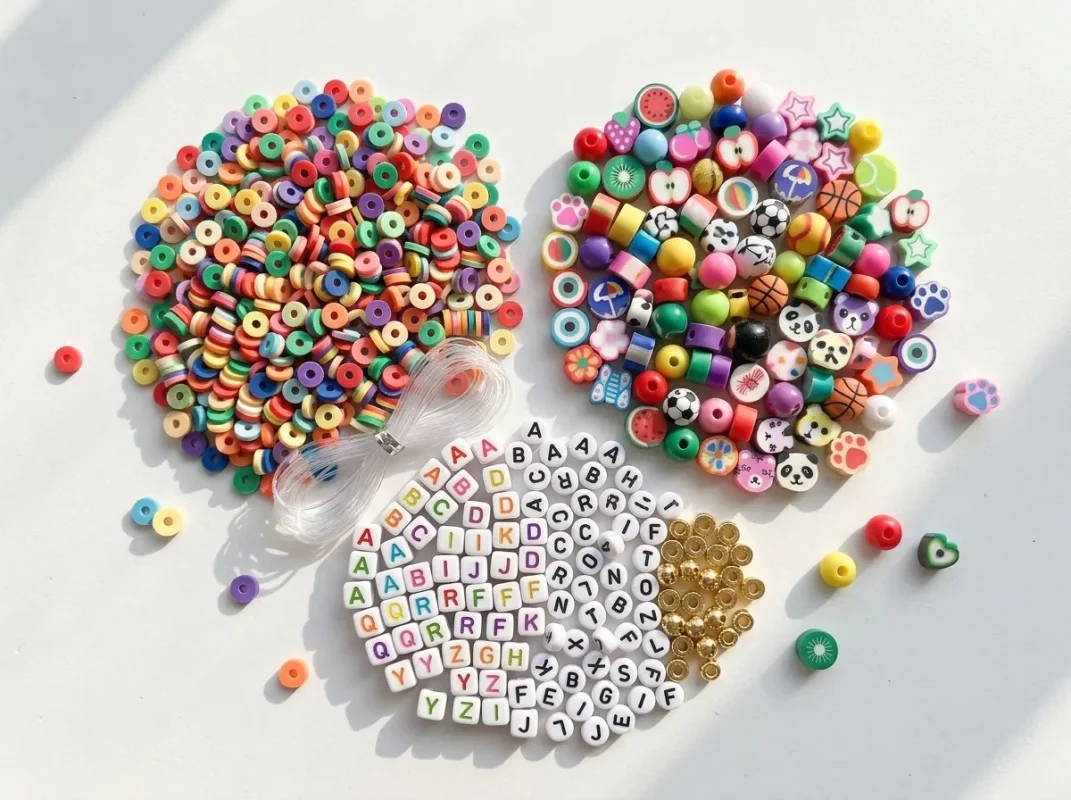
Clay heishi beads (recommended for beginners) Flat disc-shaped beads, typically 6mm diameter. The holes are consistently sized, and the cord passes through easily without a needle. They stack neatly on the wrist, and the matte finish photographs well. One bracelet uses approximately 40–50 clay beads depending on wrist size; for context, a full setup like our kit provides 5,000 beads in 48 colors, which is enough to make 50+ adult-sized bracelets. All our clay beads are ASTM F963 and EN71 certified, meaning they are lead-free, cadmium-free, and non-toxic.
Our founder, Maya Dillon, personally smell-tests every batch of beads we source. If a batch has that sharp, heavy plastic odor that often signals low-grade chemicals, she rejects it immediately.
Acrylic round beads (6mm–8mm) The most widely available option. At 6mm–8mm, the holes are large enough for 0.8mm cord without a needle. Lightweight, consistent sizing, available in a wide color range. A good general-purpose choice.
Letter beads: If the goal is to spell a name or word, letter beads are typically 7 mm cube-shaped acrylic beads. One thing worth checking before you buy: vowel quantity. Most standard packs include equal numbers of every letter, which means you’ll run out of E, A, and I quickly. Look for vowel-weighted packs that include extra A, E, I, O, and U beads, or buy vowels separately.
What to avoid for a first bracelet: Seed beads (too small, holes too narrow for 0.8 mm cord without a needle), glass beads under 6 mm (same issue), and wooden beads with unfinished holes (cord frays).
The tools you actually need
Beyond cord and beads, the list is short.
- Scissors. Any pair that makes a clean cut. Craft scissors are ideal because the blades are sharp enough to cut elastic cord cleanly without fraying the end. Kitchen scissors work. Nail scissors work. The only type to avoid is dull scissors that crush the cord instead of cutting it—a crushed end is harder to thread through beads.
- A binder clip. Clip it 2 inches from one end of the cord before you start threading. It acts as a stopper so beads don’t slide off the other end while you work. A piece of masking tape folded over the end works just as well.
Optional but useful: A ruler or measuring tape to cut the cord to the right length before you start. Not strictly necessary — you can wrap the cord around your wrist to estimate — but it removes one variable from the process.
That’s the complete tool list. You do not need a bead board, a bracelet mandrel, a knotting tool, or any jewelry-making hardware for this style of bracelet.
What you don’t need
This section exists because bracelet supply lists online are frequently written to maximize what you buy, not to tell you what’s actually required.
- You don’t need a needle. With a 0.8 mm cord and beads 6 mm or larger, the cord is stiff enough to thread directly. A needle only becomes necessary with seed beads or very fine cord.
- You don’t need a bead board. A bead board helps you plan designs before threading. Useful for complex patterns, unnecessary for a first bracelet. A flat table does the same job.
- You don’t need clasps or crimp beads. These are for bracelets that use wire or non-stretch cord with a clasp closure. Elastic bracelets close with a knot, not hardware.
- You don’t need pliers. Pliers are for wire work. They play no role in a beaded elastic bracelet.
- You don’t need glue — usually. A properly tied surgeon’s knot on 0.8 mm cord doesn’t need adhesive to hold. The exception: if you’re making bracelets for very young children who tend to pull at things, a single drop of clear nail polish on the dried knot adds a layer of security.
Getting everything at once vs. buying separately
If you buy materials individually, the minimum shopping list is: one spool of 0.8mm elastic cord, one pack of beads, and scissors (which most people already own). The main risk with buying separately is the cord thickness issue — it’s easy to grab the wrong size if you’re not looking carefully.
The alternative is a kit that includes pre-specified materials. A well-designed kit removes the cord thickness decision entirely, because the right spec is already in the box. It also solves the vowel problem for letter beads, since kits that prioritize the maker’s experience weight the bead mix toward higher-frequency letters.
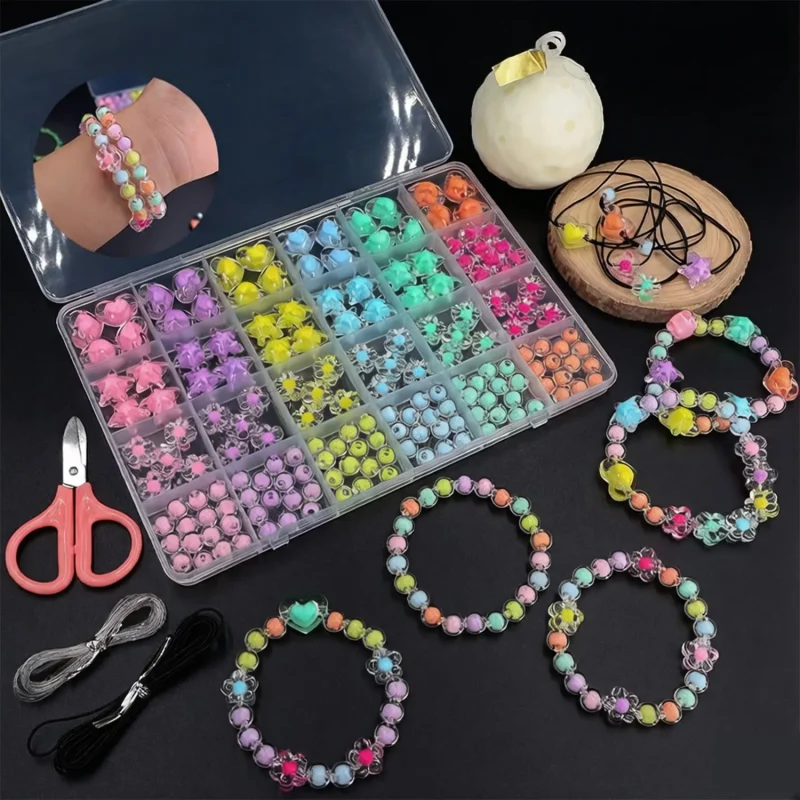
Our bracelet-making kits include 0.8 mm elastic cord, 5,000 beads across 48 colors with a vowel-weighted letter bead mix, scissors, and a storage case—organized by color, not dumped loose. If you’d rather start making than start shopping, that’s the faster path.
For the next step — what to actually do with these materials — see our guide on how to make bracelets with beads.
FAQ
Can I use standard 0.5mm cord if that’s all I can find?
We don’t recommend it for beginner projects. While 0.5mm cord is common in craft stores, it lacks the tensile strength to survive daily wear; our 0.8mm TPU cord is rated for 5,000+ stretch cycles, providing a significantly more reliable result.
Do I need jewelry glue to secure the knot?
Usually, no. A properly tied surgeon’s knot on our 0.8mm cord is designed to hold without adhesive. If you are making jewelry for very young children, a single drop of clear nail polish on the knot adds an extra layer of security.
Are all clay beads the same quality?
No. Low-quality beads often have a strong chemical smell or inconsistent thickness. All Beadlo beads are ASTM F963 and EN71 certified, ensuring they are non-toxic, lead-free, and cadmium-free.
About this article: Written by Maya Dillon, Founder at Beadlo. Content is based on hands-on kit testing, direct supplier evaluation, and questions collected from our customers. Where conclusions are based on our own observation rather than third-party testing, this is noted in the text. Last reviewed: April 2026
